
- Written by: zestra
- November 16, 2026
- Categories: Uncategorized
- Tags:
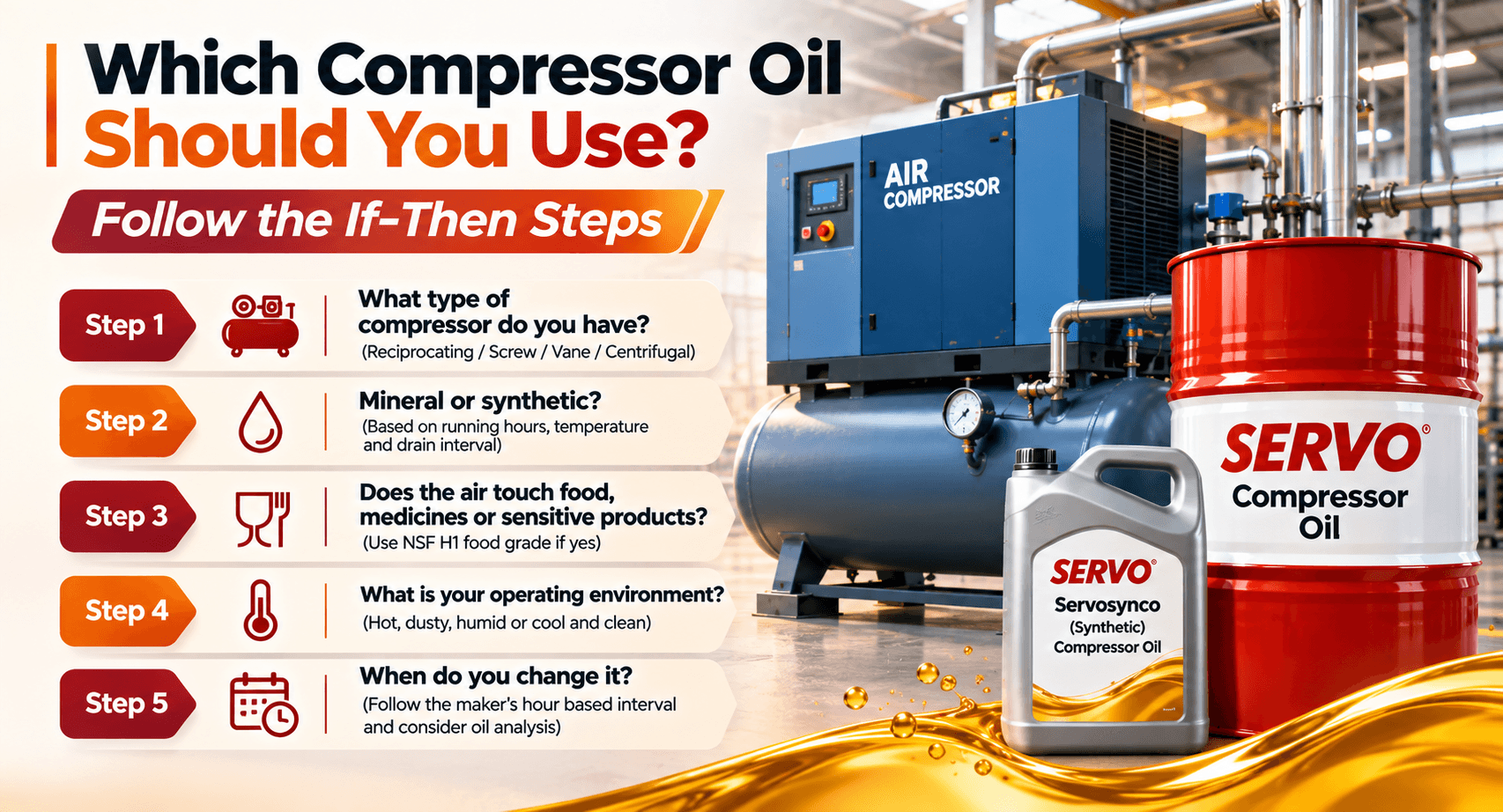
Which Compressor Oil Should You Use? Follow the If-Then Steps
Almost every factory has a compressor, and almost every compressor gets whatever oil was cheapest or nearest the last time someone ordered. The result is carbon in the valves, oil in the air line, and an overhaul that arrives early.
Instead of a long explanation, here is a simple decision path. Start at step one and follow it.
Step 1: What type of compressor do you have?
If it is a reciprocating (piston) compressor: the oil faces high discharge temperatures around the valves, and the main enemy is carbon build-up. Choose a compressor oil with strong oxidation stability and low carbon forming tendency. Servo Press grades are the usual mineral oil choice in this class, selected by viscosity grade as per the compressor maker.
If it is a rotary screw compressor: the oil does more jobs at once. It seals the rotors, cools the air and lubricates bearings. It needs good thermal stability and quick separation from air and water. Many screw compressor makers recommend specific oils or fluid types, so check the manual first.
If it is a rotary vane compressor: these like a steady film and good wear protection. Follow the viscosity grade the maker names.
If it is a centrifugal compressor: these are often lubricated with turbine type oils. Check the specification before choosing.
Step 2: Mineral or synthetic?
If the compressor runs a few hours a day in moderate conditions: a good mineral compressor oil is usually enough, and it keeps cost down.
If it runs close to continuous, in a hot room, or you want longer drain intervals: a synthetic compressor oil is worth a look. It resists heat better and often lasts longer between changes. Indian Oil’s synthetic compressor range is sold under the Servosynco name, so ask us about availability for your grade.
If you are unsure: follow the manual. Warranty often depends on it.
Step 3: Does the air touch food, medicines or sensitive products?
If yes: use a food grade (NSF H1) compressor oil, and keep air filtration in good order. Servo has food grade compressor oils in its range, and we can check availability for you.
If no: a standard compressor oil is fine.
Step 4: What is your operating environment?
If it is hot, dusty or humid, as in a typical Gujarat summer shed: shorten your check intervals, keep intake filters clean and watch oil colour. Heat ages oil far faster than people expect.
If the room is cool and clean: you can usually stay closer to the maker’s standard change interval.
Step 5: When do you change it?
Follow the compressor maker’s hour based interval first. As a rough guide, mineral oils are often changed sooner than synthetics, but conditions change this a lot. Do not rely on the calendar alone, and do not rely on colour alone. Oil analysis once or twice a year is cheap insurance on important machines.
Three warning signs the oil is wrong
- Dark, burnt smelling oil long before the change is due.
- Carbon deposits on valves or in the discharge line.
- Oil mist in the air line or rising oil consumption.
If you see any of these, send us the compressor model and what you are using now.
Mistakes worth avoiding
- Topping up with a different oil type without checking compatibility.
- Using automotive engine oil in an industrial compressor.
- Ignoring the oil filter and separator element, which are part of the oil system.
Supply and support
Uma Steel Traders is an authorized Servo stockist in Sanand. We supply compressor oils to plants across Ahmedabad, Sanand, Viramgam, Mandal, Detroj, Banaskantha and Patan, in barrels and smaller packs.
Share your compressor make, model and operating hours and we’ll point you to the right Servo grade.
Call us at +91 74340 10606 or see the Industrial Lubricating Oils page.
Frequently Asked Questions
Can I use hydraulic oil in an air compressor?
Not as a substitute. Compressor oils are made for the heat and oxidation conditions inside a compressor. Use the grade the maker specifies.
How often should screw compressor oil be changed?
It depends on the oil type and operating conditions. Follow the maker’s interval, and use oil analysis if you want to stretch it safely.
Is synthetic compressor oil worth the extra cost?
For continuous duty, hot environments or long drain targets, often yes. For light intermittent use, mineral oil is usually fine.
Do you supply small quantities for a single compressor?
Yes. We supply barrels and smaller packs.