
- Written by: zestra
- November 3, 2026
- Categories: Uncategorized
- Tags:
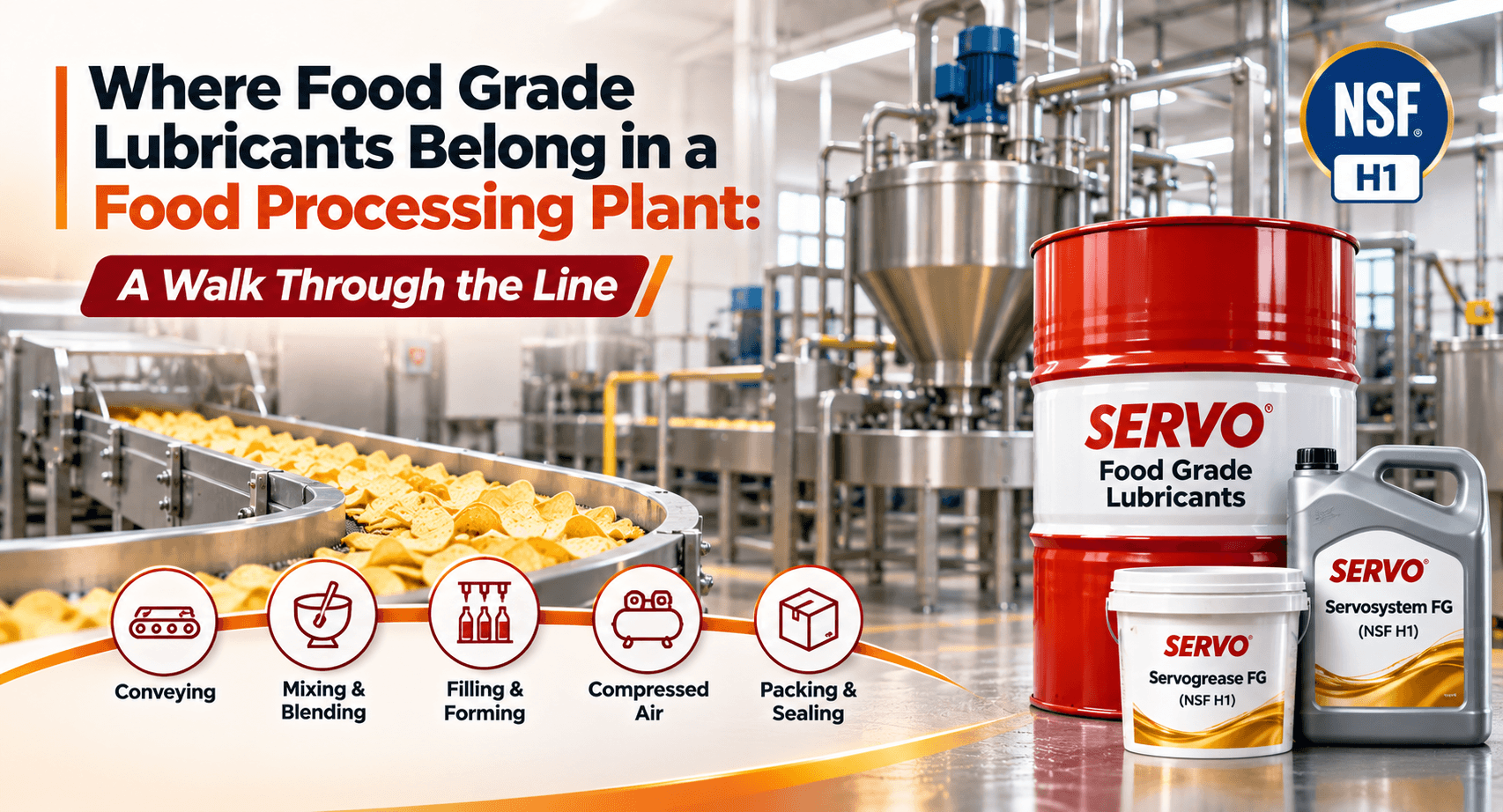
Where Food Grade Lubricants Belong in a Food Processing Plant: A Walk Through the Line
Most plants know they need “food grade” oil somewhere. Fewer know exactly where, and that gap is where audit findings and awkward customer calls come from. So let’s skip the theory and walk the plant floor, from raw material to packing, stopping at each spot where a lubricant sits close to food.
First, what “food grade” really means
The term you’ll see on data sheets is NSF H1. It marks lubricants that are acceptable where there is a chance of incidental food contact, meaning a drop of oil or a smear that could reach the product by accident. It does not mean you can pour it on food, and it does not replace good housekeeping. H1 is the category most food plants look for around open product zones.
Indian Oil has a food grade family under the Servo name. Public product literature lists Servosystem FG for hydraulics, Servosyngear FG for gear drives, Servosynco FG H1 for compressors and Servogrease FG grades for bearings, all registered with NSF in the H1 category. Availability of individual grades varies, so check with us before you plan an order.
Stop 1: receiving and conveying
Conveyors run all day, usually with bearings and chains very close to open product or packaging. Chains and bearings here are the classic place for food grade grease. A normal grease is cheaper, but one drip onto a product belt can mean a rejected batch.
Stop 2: mixers, kneaders and blenders
Gearboxes on mixers sit just below or beside the product bowl. Seals wear, and small leaks happen. A food grade gear oil in these gearboxes turns a leak from a contamination event into a clean up job.
Stop 3: filling and forming machines
Hydraulic units on filling, forming and cutting machines often sit within a metre of the product. Food grade hydraulic oil is the safe choice here, particularly on machines with exposed rams or hoses over open lines.
Stop 4: the compressed air room
Many plants forget this one. Compressed air used for packing, blowing or product contact depends on the compressor oil, and oil carryover is a real risk. Food grade compressor oil reduces the consequence if a little reaches the air line. Good filtration still matters.
Stop 5: packing and sealing
Packaging machines use light oils and greases on cams, chains and bearings. Again, the question is simply how close the point is to product or packaging that touches product.
Stop 6: outside the product zone
Not everything needs food grade. A boiler feed pump, a utility gearbox in the yard or a workshop machine far from the line can run standard industrial oil. Using H1 products everywhere raises cost for no benefit. A simple zone map of the plant, marking product zones and non-product zones, saves real money.
Three mistakes we see
- Mixing food grade and regular grease in the same bearing, which cancels the benefit.
- Switching only the oil and forgetting the grease on the same machine.
- Skipping labels, so the right drum gets used on the wrong machine within a month.
Colour coded labels on grease guns and drums fix the third one cheaply.
Who should read this
Dairy, snack and namkeen units, edible oil and flour mills, beverage and bottling plants, bakery lines, spice processors and packaging units serving food companies. If you supply into larger food brands, your audit may already ask for proof of food grade lubricants.
Getting set up
Uma Steel Traders is an authorized Servo stockist in Sanand, supplying across Ahmedabad, Sanand, Viramgam, Mandal, Detroj, Banaskantha and Patan. Send us your machine list and tell us which points sit in product zones. We’ll confirm which food grade grades are available and which can stay on standard oil.
Call us at +91 74340 10606 or visit the Greases and Industrial Lubricating Oils pages.
Frequently Asked Questions
Is NSF H1 oil safe to eat?
No. H1 means it is acceptable for incidental contact only. It is not a food ingredient.
Do all machines in a food plant need H1 lubricants?
No. Only points that could reach product or packaging need them. Utility and outside machinery can use standard grades.
Can I top up an old regular grease bearing with food grade grease?
Not directly. Clean the bearing out first, because mixing greases can break the structure and undo the food grade benefit.
Do you stock Servo food grade products?
Availability depends on the grade. Call us with your requirement and we’ll confirm stock and supply time.